This story turns a decorating idea into a practical approach for real homes instead of simply presenting a look.
Define what you really want to separate in a single volume
The desire to divide a studio apartment often arises not from sound insulation, but from the view of the bed from the door, the mixing of work and rest, or the need for privacy when guests arrive. Naming the problem correctly allows choosing a lighter and flexible solution instead of an unnecessary wall.
Follow the routes around the house for a day: how to get from the entrance to the kitchen, from the bed to the bathroom, and from the table to the window. If the divider is placed on these lines, it produces a narrow corridor instead of gaining square meters. Before purchasing fixed furniture, use tape to mark the boundary on the floor and the passage that must remain open.
Protect the light path starting from the window direction
A closed-to-ceiling partition in a single-window home may leave the rear area dependent on artificial light throughout the day. Although placing the bed close to the window may seem comfortable, it can leave the living area dark. Clearly show on the plan the flow of light between the window, entry and main seating point.
An open shelf, spaced slats, or translucent curtain allow light to pass through while filtering the image. However, do not automatically assume that ventilation and heat circulation have been solved just because "light is permeable". Do not block the area around radiators, air conditioners and vents; Verify the placement in accordance with the technical condition of the house.
“In the studio, a good divider won't cut the room in half; It provides privacy and allows light and air to remain common.”
Consider curtains the most flexible layer of privacy
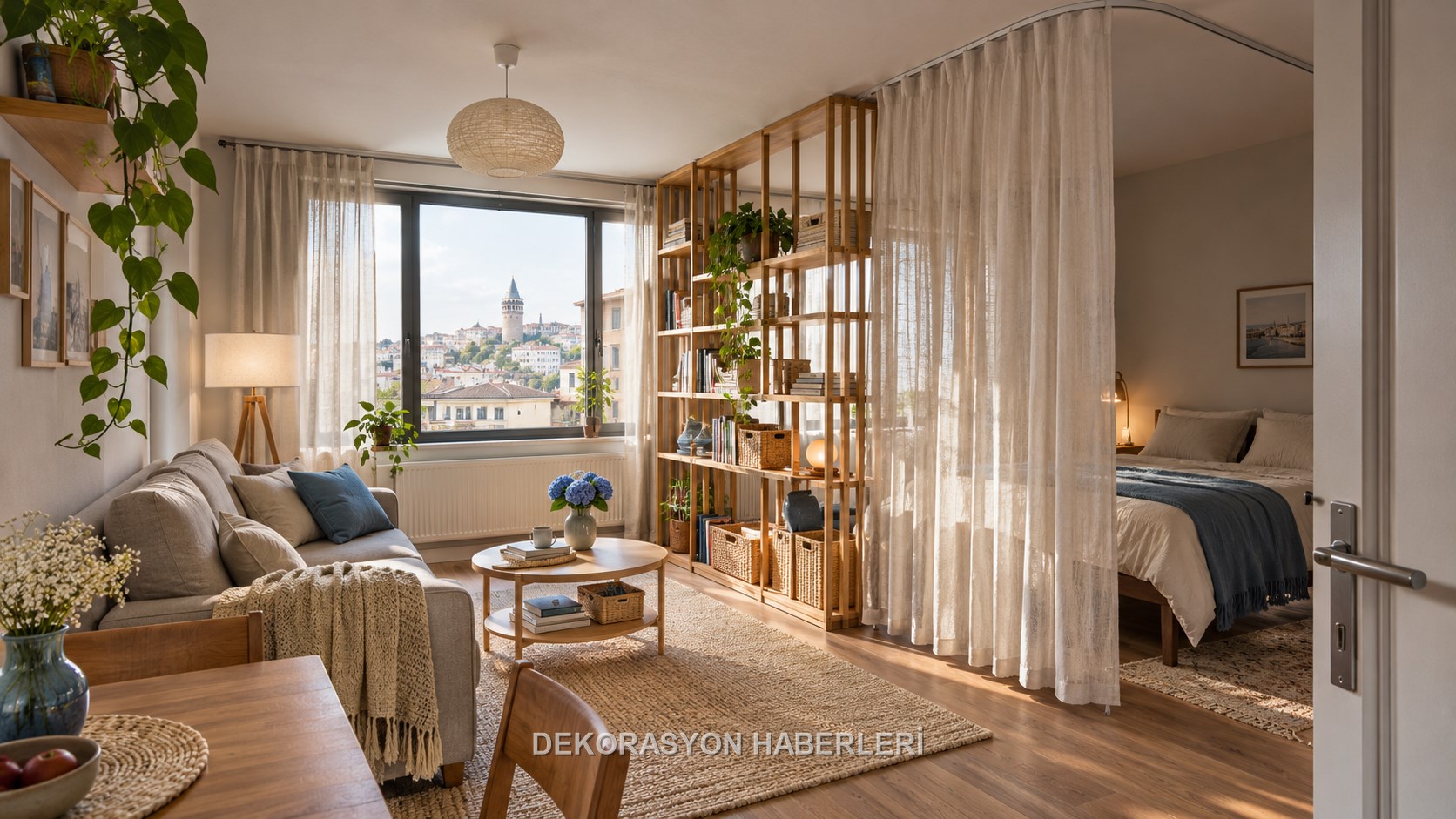
Moving on the ceiling rail, the curtain can be opened completely during the day and hide the bed at night. Fabric density, light transmittance and two side views should be tested with the sample. While fabric that is too heavy creates a large mass in a small volume, tulle that is too thin may not provide the expected privacy.
Check the total load that the rail will carry and the ceiling structure before installation. The curtain should not crawl on the floor, should not come close to kitchen heat or an open flame, and should not gather in the main passage. Two-way opening can facilitate access to the bed and closet from both sides.
Don't turn an open shelf into a storage wall
Open shelving, accessed from two directions, offers space for books and a small number of objects while partially hiding the bed. Filling the entire shelves with boxes and decor reduces light transmittance and visually brings it closer to the closed wall. Maintain free space and only place items that are actually used.
There is a risk of a free-standing high shelf tipping over; Secure fixing to a suitable wall or ceiling may be required. Do not place heavy items that may fall at the head of the bed. Shelf depth should not narrow the passage, sharp corners should not remain at shoulder level, and earthquake safety should be evaluated according to local conditions.
Break the look with furniture aspect
Sometimes, without buying a separate divider, the back of the sofa, the foot of the bed, or the direction of the desk make two areas readable. Even a change of direction of a few degrees may be enough to move the bed out of the direct line of sight of the entry door. This method does not cut the ground and light.
Adding a slim console to the seat back can reinforce the border, but it's not essential in the home where every inch counts. First, just change the direction. If the headboard will be a visual separator, choose a form that is sturdy, cleanable and does not get stuck in circulation.
Protect the air and access of the sleeping area
Leave enough movement around the bed to change sheets, open the closet door, and get up at night. Although completely closing the bed from three sides saves space in the short term, daily maintenance and use by two people may become difficult. Keep at least one convenient access line uninterrupted.
If the fabric or panel covering the sleeping area restricts airflow, moisture and odor may accumulate in the morning. It is important to leave the curtains open during the day, ventilate regularly and not completely squeeze the bed against the cold surface of the external wall. If there is constant condensation, examine the structure-related problem with an expert.
Test the partition with day and night scenario
Open the curtains during the day, set up work and eating arrangements; Turn it off at night and walk from bed to the bathroom. Check that the light switch, outlets and window handle remain accessible. Also consider where to leave bags and coats without spilling into the sleeping area when guests arrive.
The divider must be fixed so that it does not narrow the escape route and does not impair the function of security equipment such as smoke detectors. Instead of imitating two tiny rooms, the successful studio plan allows a single volume to be opened and closed to different degrees at different times.
Related guides: choosing multi-purpose furniture
Allow the plan to change
Working, sleeping and guest habits in the studio home may change over time. Keeping the divider rearrangable in terms of rails, modules or furniture, instead of locking it only to the current bed size, provides advantages in moving and living changes.
In the first month of the new layout, note which panel remains open all the time, where stuff accumulates, and at what times the light dims. Removing or lightening the unused section is not a failure, but improving the single volume according to the actual behavior.
Preserving window light while removing the bed from entry view; Studio layout guide comparing curtain, open shelving and furniture orientation to size.
Decision table
Application checklist
- ✓Define what you really want to separate in a single volume
- ✓Protect the light path starting from the window direction
- ✓Consider curtains the most flexible layer of privacy
- ✓Don't turn an open shelf into a storage wall
- ✓Break the look with furniture aspect
Most common mistake
Open the curtains during the day, set up work and eating arrangements; Turn it off at night and walk from bed to the bathroom. Check that the light switch, outlets and window handle remain accessible. Also consider where to leave bags and coats without spilling into the sleeping area when guests arrive. The divider must be fixed so that it does not narrow…
Care note
A closed-to-ceiling partition in a single-window home may leave the rear area dependent on artificial light throughout the day. Although placing the bed close to the window may seem comfortable, it can leave the living area dark. Clearly show on the plan the flow of light between the window, entry and main seating point. An open shelf, spaced slats, or…
Frequently asked questions
What should be decided first for Dividing a studio without blocking light?+
The desire to divide a studio apartment often arises not from sound insulation, but from the view of the bed from the door, the mixing of work and rest, or the need for privacy when guests arrive. Naming the problem correctly allows choosing a lighter and flexible solution instead of an unnecessary wall. Follow the…
What should be checked before measuring and installation?+
A closed-to-ceiling partition in a single-window home may leave the rear area dependent on artificial light throughout the day. Although placing the bed close to the window may seem comfortable, it can leave the living area dark. Clearly show on the plan the flow of light between the window, entry and main seating…
Which criteria matter when choosing materials?+
Moving on the ceiling rail, the curtain can be opened completely during the day and hide the bed at night. Fabric density, light transmittance and two side views should be tested with the sample. While fabric that is too heavy creates a large mass in a small volume, tulle that is too thin may not provide the expected…
How should the maintenance plan be organised?+
A closed-to-ceiling partition in a single-window home may leave the rear area dependent on artificial light throughout the day. Although placing the bed close to the window may seem comfortable, it can leave the living area dark. Clearly show on the plan the flow of light between the window, entry and main seating…