This story turns a decorating idea into a practical approach for real homes instead of simply presenting a look.
Watch the first thirty seconds of the intro
When you enter the house, observe for a few days where your keys, bag, coat and shoes are left. Clutter often arises not from excess items, but from the lack of appropriate response at the point where the movement begins. Designate a single stop for each daily item, close to the door.
Measure the full opening of the exterior door, counter cover, room doors and the narrowest point of the corridor. Think about how many steps are taken on clean ground with wet shoes. The storage module should not narrow this route, and should preserve the space where the incoming person can close the door and take off his clothes.
Design the shallow closet according to the items inside
The standard deep cabinet can create a heavy block at shoulder height in a narrow hallway. Shallow solutions that place the shoe at an angle or sideways provide passage; However, whether larger sizes and boots actually fit should be checked with a sample. Hinge and door movement are as important as external dimensions.
A closet with a door provides visual calm, but closing stuffy shoes can accumulate odor and moisture. Plan for backspace, vents or regular ventilation. Instead of narrow compartments that are difficult to clean, the removable shelf and wipeable inner surface are more functional in the long run.
“What makes the entryway refreshing is not the loss of storage, but the fact that it gets out of the way of entry movement.”
Separate daily items from seasonal items
Keeping every coat and shoe in the entryway turns the small space into storage. Keep the items used that week in an accessible section, and keep seasonal and special occasion items in another cabinet. This separation allows you to create a tidier entryway with smaller furniture.
Allocate limited hooks per person to open hanger; The remaining coats should go to the closed section. The child's hook must be accessible and the adult's hook must be at a height that will not get caught in the passage. Do not hang the heavy bag on the hook with weak adhesive; Verify wall type and connection capacity.
Don't underestimate the seating and dressing point
A thin bench to sit on while wearing shoes increases comfort, especially in homes with children or people with limited mobility. The depth of the bank should not block the passage and it should not be an unstable structure that would encourage climbing on it. A clear, cleanable space can be left underneath for daily shoes.
If a separate bench does not fit, a surface designed by the manufacturer for seating can be used in a solid part of the cabinet. Don't just sit on the shoe rack. If a cushion is to be chosen, a thin model that is dirt-repellent, has a removable cover and does not prevent door friction is more practical.
Set up a landing pad for keys and small items
A stable surface next to the door for keys, cards and headphones, even a palm-sized one, reduces daily clutter. Instead of a deep console, a shallow shelf, wall pocket or in-cabinet tray can be used. Do not leave valuables visible and easily accessible from outside.
Create a separate vertical section for mail and paper; Put in place a weekly elimination routine. Do not keep perfume, batteries or electronic devices above the radiator. If a charging point is planned, do not leave the cable in transit and obtain competent support for permanent electrical intervention.
Provide safe exit control with mirror and light
A mirror can visually open up a narrow space, but right opposite the exterior door it can create harsh reflections and privacy issues. A full-length mirror on the side wall or securely fixed to the cabinet door is more controlled. Be careful not to let the edges catch on the shoulder when passing.
When the ceiling light stays behind the head, the face is shadowed in the mirror. A soft wall light near the mirror makes output control easier. Sensor light can be useful at night; However, it will bother you if it constantly triggers incorrectly. Keep the color temperature consistent with adjacent areas of the home.
Choose material based on dirt, water and impact
The entrance floor is exposed to sand, water and salt coming from outside more than other rooms. Use a non-slip, easy-to-wipe mop; Check that it is not stuck under the door. Skirting and joint details under the cabinet should prevent water from accumulating at the edges.
The high-gloss dark cover shows every fingerprint, while the delicate light fabric can quickly tire. The matte and wipeable surface, durable edge banding and replaceable hardware provide longer life. When choosing paint, take into account the cleanability data in high-contact areas.
Tie the budget in the right order and security
First comes the sorting and behavior order, then the landing area with the hook, then shallow storage and lastly the decorative accessory. Changing the shelves or ventilating the door of the existing closet can make a big difference without renovating the entire entryway.
Secure high and narrow furniture to a suitable wall to prevent it from tipping over. Do not block access to the meter and electrical panel or narrow the escape route. At the final check, open the outer door completely, let two people move side by side and try the cleaning scenario on a wet day.
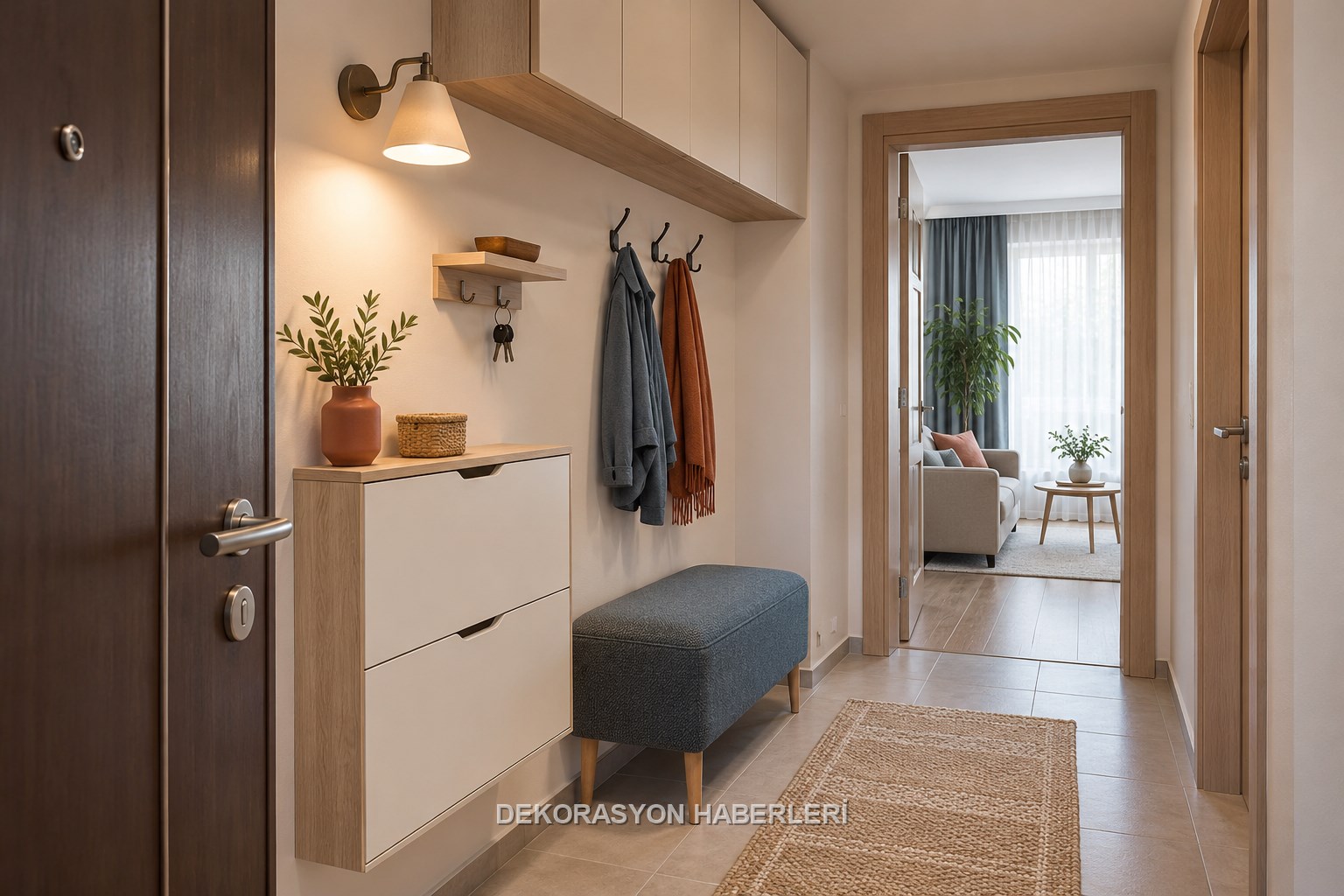
An exemplary solution that maintains a comfortable passage size while collecting shoes, bags and daily items on a single wall.
Decision table
Application checklist
- ✓Watch the first thirty seconds of the intro
- ✓Design the shallow closet according to the items inside
- ✓Separate daily items from seasonal items
- ✓Don't underestimate the seating and dressing point
- ✓Set up a landing pad for keys and small items
Most common mistake
When you enter the house, observe for a few days where your keys, bag, coat and shoes are left. Clutter often arises not from excess items, but from the lack of appropriate response at the point where the movement begins. Designate a single stop for each daily item, close to the door. Measure the full opening of the exterior door, counter cover, room doors…
Care note
First comes the sorting and behavior order, then the landing area with the hook, then shallow storage and lastly the decorative accessory. Changing the shelves or ventilating the door of the existing closet can make a big difference without renovating the entire entryway. Secure high and narrow furniture to a suitable wall to prevent it from tipping over.…
Frequently asked questions
What should be decided first for Storage that does not block a narrow entrance?+
When you enter the house, observe for a few days where your keys, bag, coat and shoes are left. Clutter often arises not from excess items, but from the lack of appropriate response at the point where the movement begins. Designate a single stop for each daily item, close to the door. Measure the full opening of the…
What should be checked before measuring and installation?+
The standard deep cabinet can create a heavy block at shoulder height in a narrow hallway. Shallow solutions that place the shoe at an angle or sideways provide passage; However, whether larger sizes and boots actually fit should be checked with a sample. Hinge and door movement are as important as external…
Which criteria matter when choosing materials?+
Keeping every coat and shoe in the entryway turns the small space into storage. Keep the items used that week in an accessible section, and keep seasonal and special occasion items in another cabinet. This separation allows you to create a tidier entryway with smaller furniture. Allocate limited hooks per person to…
How should the maintenance plan be organised?+
First comes the sorting and behavior order, then the landing area with the hook, then shallow storage and lastly the decorative accessory. Changing the shelves or ventilating the door of the existing closet can make a big difference without renovating the entire entryway. Secure high and narrow furniture to a suitable…